Stakeholders in the education and disability sectors have called for stronger commitment towards inclusive education to ensure that children with intellectual disabilities and other special needs have equal access to quality learning opportunities.
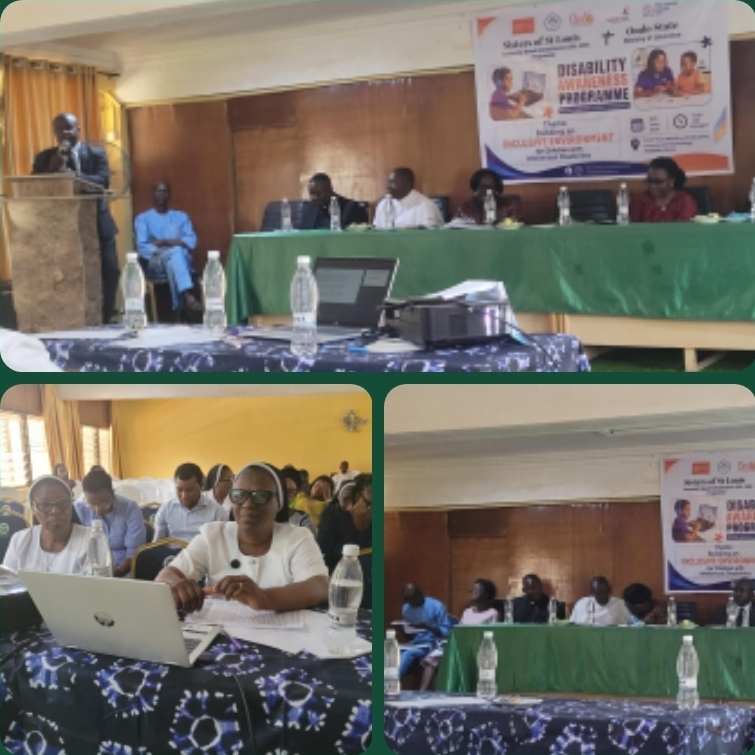
The call was made at a Disability Awareness Programme held at the Ondo State Ministry of Education, Akure, under the “We Ring the Bell” initiative organised by the Sisters of St. Louis Community-Based Rehabilitation (SSL-CBR) Programme in collaboration with the Ondo State Ministry of Education, Science and Technology.

In her welcome address, the Coordinator of SSL-CBR, Sr. Victoria Orifunmishe, said the programme was a call to action for Ondo State to fully embrace and implement inclusive education policies that guarantee opportunities for all learners, regardless of their abilities.
She noted that children with intellectual disabilities have the right and potential to learn, grow and thrive alongside their peers when provided with the right environment and support. According to her, the initiative was aimed at ensuring that inclusion becomes a reality in schools and communities across the state.
Sr. Orifunmishe urged stakeholders, including government agencies, educators, parents and advocates, to take deliberate steps towards creating supportive learning environments where children with disabilities are valued and empowered. She expressed optimism that discussions from the programme would translate into practical policies, transformed schools and improved opportunities for children with special needs.

Delivering the keynote address, the Permanent Secretary, Ondo State Ministry of Education, Science and Technology, Dr. Akindele Ige, reaffirmed the state government’s commitment to inclusive education, stressing that no child should be excluded from learning opportunities because of disability.
Dr. Ige commended the Sisters of St. Louis for their dedication to promoting community-based rehabilitation and inclusive education, describing the “We Ring the Bell” initiative as a symbolic call to end exclusion and ensure that every child is seen, heard, supported and included.
He observed that children with intellectual disabilities often experience multiple layers of exclusion due to misconceptions about their conditions and limited access to educational support. He emphasized that disability is part of human diversity and that children with disabilities can develop their abilities and contribute meaningfully to society when given appropriate support.
The Permanent Secretary assured stakeholders that the ministry would continue to strengthen teachers’ capacity, improve learning materials and promote accessible school infrastructure to support all learners. He added that the ministry would sustain collaboration with the Sisters of St. Louis to deepen inclusive education practices across schools in Ondo State.
He also urged teachers, school administrators, parents and community leaders to work together in identifying and supporting children with intellectual disabilities early, while highlighting the role of science and technology, including assistive learning tools, in improving educational outcomes.
Representing the Catholic Bishop of Ondo Diocese, Bishop Jude Arogundade, Rev. Fr. Dominic Adeosun commended the organisers for promoting the dignity and inclusion of children with disabilities. He described the programme as a reflection of the Church’s commitment to supporting vulnerable members of society and called for collective efforts to eliminate stigma and create equal opportunities for all children.
In his goodwill message, the Education Secretary of the Catholic Diocese of Ondo, Rev. Fr. Valentine Omolakin, described inclusive education as “an idea whose time has come,” stressing the need for greater support and promotion of the initiative.
Rev. Fr. Omolakin said although the concept was still developing in the state, he immediately recognised its importance when he learnt about the programme and gave it priority attention. He noted that the initiative had grown beyond the work of the Sisters of St. Louis Community-Based Rehabilitation Programme to become a project receiving wider support under the administration of Governor Lucky Aiyedatiwa.
He called for sustained partnership among stakeholders, stressing that children with intellectual disabilities should not be viewed only from a spiritual perspective or treated as victims of spiritual affliction. He advocated understanding, acceptance and proper educational support, while recalling the long history of service by the Sisters of St. Louis, including the establishment of a leprosarium in 1948 before government intervention in the area.
Also speaking during the programme, Sr. Christie Udebor of SSLCBR highlighted the importance of inclusive education, describing it as a process of making education more accessible, increasing participation and reducing exclusion from school curricula, cultures and communities.
She explained that the global movement for inclusive education gained momentum at the 1994 World Conference on Special Needs Education in Salamanca, Spain, where Nigeria was among the countries that endorsed the Salamanca Statement on inclusive education.
According to her, inclusive education requires a whole-system approach where schools, teachers, policies and communities work together to support diverse learners. She identified key features of inclusive education to include supportive teachers, accessible learning environments, respect for diversity, effective policies and recognition of every learner’s potential.
Tracing the history of disability inclusion, Sr. Udebor explained that societies had moved from eras of denial, prohibition, segregation and isolation to the current era of inclusion, where learners with disabilities are encouraged to learn alongside their peers with the necessary support.
She stressed that teachers and school administrators are central to achieving successful inclusion, describing them as the drivers of change in schools. She highlighted the need for accessible infrastructure, including ramps and supportive classroom environments that allow every learner to participate fully.
Sr. Udebor commended St. Louis Nursery and Primary School for creating an inclusive environment where learners and staff support children with disabilities, making integration more effective.
She added that inclusive education benefits everyone, noting that children with disabilities gain a sense of belonging, improved participation and access to opportunities, while learners without disabilities develop greater understanding, respect for diversity and stronger social skills.
She further explained that society benefits when persons with disabilities are educated and empowered because they are better positioned to contribute economically and live independent lives, while teachers gain improved professional skills through exposure to diverse learning needs.
The programme ended with a renewed commitment by stakeholders to build schools and communities where every child, regardless of ability, has a voice, a place and a future.