The Federal Government says the second National Industrial Manpower Summit, NIMS 2.0, will focus on developing a skilled workforce capable of driving Nigeria’s industrial transformation.
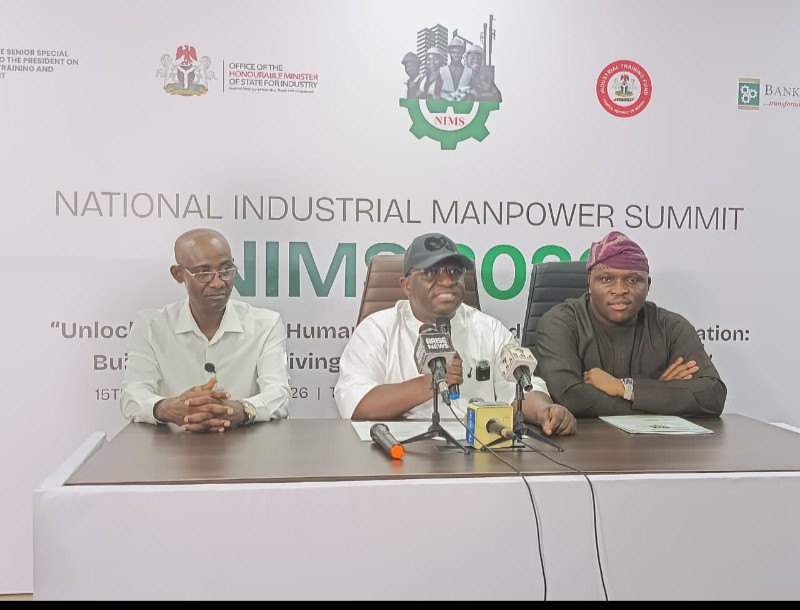
The Senior Special Assistant to the President on Industrial Training and Development, Hon. Adamson Oluwatosin Ayinde, disclosed this at a joint press conference to announce the 2026 edition of the summit.
According to him, the summit, scheduled for October 15 and 16 at the State House Banquet Hall, Presidential Villa, Abuja, will be held under the theme, “Unlocking Nigeria’s Human Capital for Industrial Transformation: Building Skills, Driving Innovation and Creating Prosperity.”
Hon. Ayinde said NIMS was established as a Presidential platform to address the need for a skilled, productive and innovative workforce to support Nigeria’s industrial development.
He recalled that the inaugural edition in 2025 attracted more than 2,500 delegates from over 10 countries, with about 120 speakers and resource persons, while more than five Memoranda of Understanding were signed.
The Presidential aide explained that the recommendations from the maiden summit had continued to inform policy engagements and interventions.
He identified the development of a national skills architecture, increased attention to manpower development in the National Industrial Policy and the free registration and training of more than 250,000 nano, micro and small businesses as some of the developments since the maiden summit.
Hon. Ayinde also announced that work had commenced on a National Industrial Manpower Competence Registry/Portal, in partnership with the Industrial Training Fund, ITF, and the Bank of Industry.
He said the initiative would help address inadequate data on available industrial skills and projected manpower requirements in the country.
The Senior Special Assistant explained that NIMS 2.0 would focus on four strategic areas, including reforming workforce development for industrial growth, preparing Nigerian talent for emerging industries and future technologies, converting skills into jobs and enterprises, and positioning Nigeria as Africa’s hub for industrial talent and innovation.
He said the summit would advance the development of a 10-year National Industrial Workforce Strategy, sector-specific workforce roadmaps, stronger Technical and Vocational Education and Training, TVET, and apprenticeship systems.
It would also deepen industry-academia collaboration and promote skills development in emerging areas such as Artificial Intelligence, robotics, automation, renewable energy and advanced manufacturing.
Also speaking, the Director-General and Chief Executive Officer of the Industrial Training Fund, ITF, Dr. Afiz Oluwatoyin Ogun, described NIMS as a platform for bridging the gap between education, vocational training and the manpower needs of industry.
Dr. Ogun said the maiden edition strengthened public-private sector collaboration and provided a launch pad for expanded apprenticeship, artisan and technician upskilling initiatives across the six geopolitical zones.
He said the ITF, as Co-Host and Principal Partner, would bring its more than five decades of experience in skills development, nationwide training infrastructure and strong industry partnerships to NIMS 2.0.
The ITF Director-General said the Fund would support the development of the 10-year National Industrial Workforce Strategy Roadmap, reforms in technical and vocational skills training and standardised skills certification.
He added that the summit would promote stronger partnerships for mobilising resources, scaling skills development and integrating skilled Nigerian talent into manufacturing, technology and other critical industrial sectors.
Dr. Ogun urged the private sector, investors and industry leaders to participate actively in the summit, saying the initiative would help build a stronger talent pipeline, improve productivity, create sustainable employment and enhance Nigeria’s global competitiveness.
Both speakers stressed that the success of NIMS 2.0 would depend on translating summit resolutions into concrete programmes, partnerships and measurable deliverables.
They therefore called on government institutions, industry, academia, development partners, professional bodies, organised labour and young Nigerians to support the initiative.
They maintained that Nigeria’s industrial future depends largely on the quality, relevance and productivity of its human capital.