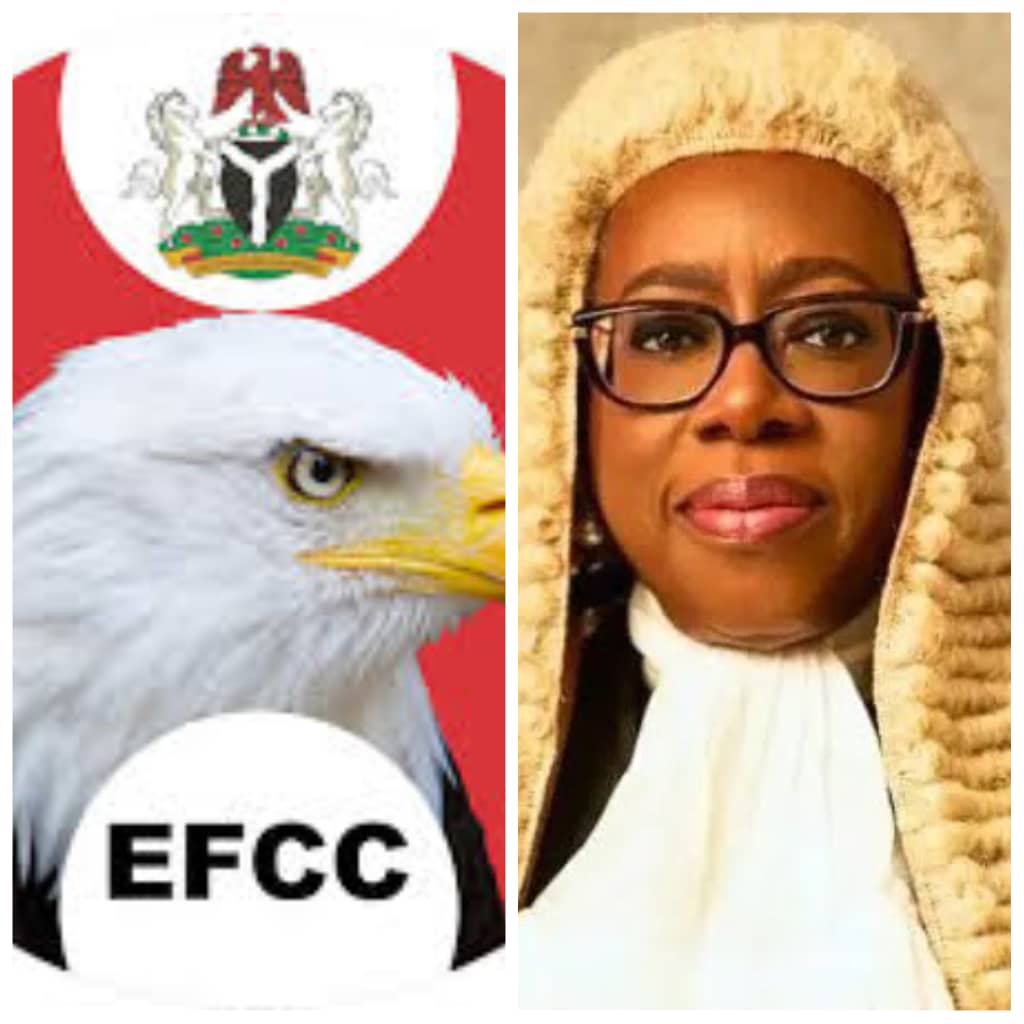
On Tuesday, 22 October, the Supreme court reserved judgment in the suit filed by nineteen states challenging the constitutionality of the laws establishing the Economic and Financial Crimes Commission, EFCC and two others to a date to be communicated to the parties. The states in the suit are Kogi, Kebbi, Katsina, Sokoto, Jigawa, Enugu, Oyo, Benue, Plateau, Cross River, Ondo, Niger, Edo, Bauchi, Imo, Osun, Nasarawa, Ogun, Taraba. The state governors had instituted the case against the Attorney General of the Federation to determine the legality or otherwise of the Economic and Financial Crimes Commission (EFCC), the Nigerian Financial Intelligence Unit (NFIU), the Independent Corrupt Practices and Other Related Offences Commission (ICPC) and the Proceeds of Crimes Act.
Two states, Ogun and Cross River are challenging the assumed powers of the NFIU to dictate how much states can withdraw or control with regard to funds appropriated by the House of Assembly. The suit originally filed by the AG Kogi State – SC/CV/178/2023 – has now been joined by 15 other states. The plaintiffs, in the suit marked: SC/CV/178/2023 had argued that the Supreme Court, in Dr. Joseph Nwobike Vs Federal Republic of Nigeria, had held that it was a UN Convention against corruption that was reduced into the EFCC Establishment Act and that in enacting this law in 2004, the provision of Section 12 of the 1999 Constitution, as amended, was not followed.
After appearances by counsels to both the plaintiff and defendants, Justice Uwani Abba-Aji reserved date for a date to be communicated to both parties.
Looking at the positions of the parties involved. It is clear that the plaintiffs, the governors have maintained their stance that the EFCC Act is unconstitutional. It is a product of a United Nations Convention against corruption, and was not ratified in accordance with Section 12 of the 1999 Constitution (as amended). Section 12 of the Constitution says no treaty can have the force of law in Nigeria until it is ratified by a majority of all the Houses of Assembly in the Federation. The states argue that the EFCC Act cannot be applied to them because they were not party to it. They also argue that the agencies lack the powers and the authority to investigate and prosecute matters related to the misappropriation of public funds, citing Joseph Nwobike vs FRN as the authority to back up their claim.
On its part, the defendant, the Attorney General of the Federation, argues that the concurrence of the states as stakeholders was not necessary to make the EFCC Act valid. Two, at least three states argue that the NFIU cannot investigate, requisition documents, arrest, or invite anyone with regard to how the states manage their funds. Three, the states insist that they have the right to establish their own anti-graft agencies and not be answerable to any federal agency, since this is a Federation.
Since its creation, aside from the early stages of Mallam Nuhu Ribadu as the Chairman, the EFCC has been known as a tool for political oppression. This is helped by its mode of establishment. And it is the reason corruption has festered rather than abate.
To further restate the position of the governors, two legal luminaries and Senior Advocates of Nigeria, Femi Falana and Olisa Agbakoba agreed that there is a need to constitutionalise the EFCC. According to them, this is important as whatever grey areas that may exist in the enabling acts of the anti-graft agencies can be corrected through amendments to constitutional provisions and the acts. This is urgently needed to make the fight against corruption whole and total because at a point, the EFCC Chairman himself complained that there are corrupt elements in the EFCC. While the nation awaits the federal government to constitutionalise the EFCC, officials of the agency must be made to declare their assets. People fighting corruption must not be seen to be living above their means. They must stop media trial of any public office holder being querried for financial misappropriation, they must not allow themselves to be used as debt recovery agents, waiting to benefit from the venture. Above all, EFCC officials must focus on their core task of fighting Financial and Economic Crimes through legitimate means. It is high time EFCC was stopped from allowing itself to be used as a weapon to fight political opponent.
Talking about the judiciary, Nigerians are optimistic that the apex Court would rise to the occasion as it did on many occasions in the past and abjudicate rightly in this matter. This hope is strengthened by the inaugural speech of the Chief Justice of the Federation, Hon. Justice Kudirat Kekere – Ekun ( GCON ), where she said, "Under my leadership, the Judiciary would adhere to the principles of honesty, transparency and integrity and that independence of the judiciary is always a topical issue…… at the Supreme Court. For instance, our judgments are free from external influence. While it is essential for the judiciary, as the third arm of government, to maintain good working relationships with the executive and legislative branches, this should not be misconstrued as subservience. "This is a new dawn and a new era in the Nigerian Judiciary. I wish to assure my fellow Nigerian citizens that we are committed to working more diligently to improve public perception of the Nigerian Judiciary".